
What is the American preference for Christmas greetings? Pew Research recently posted data from a survey:
When given the option of hearing “Merry Christmas” or a less religious greeting — like “Happy Holidays” — in stores and businesses, Americans choose Merry Christmas by a 60%-to-23% margin. When specifically given “doesn’t matter” as an option, however, a 45%-plurality have no preference for how they are greeted during the holiday season — 42% want Merry Christmas and 12% prefer the less religious greeting.
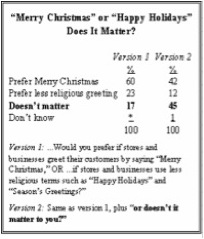
This survey focuses simply on a preference for Christmas greetings. Making conclusions on broader cultural issues with this data is difficult. But I am encouraged to see that many people still prefer “Merry Christmas” over “Happy Holidays.” What is discouraging is that, when given the option, many gravitate towards apathy (it “doesn’t matter”).
How we greet strangers, friends, and coworkers does in some small way show our religious leanings. And it does matter to a degree. Most importantly, however, may we be willing to show through our lives why the Christmas message is so urgent. After all, it’s not about a cultural battle over how to greet people during the holidays. It’s about reaching people so that they can see through the manger why the cross is central to salvation. That’s what makes “Merry Christmas” matter.
Merry Christmas Church Forward readers!




Sam,
Great post. Thanks for your observations. Have a MERRY CHRISTMAS. May the Lord bless you richly indeed.
Grace,
Chris Aiken
pastor@calvaryofpensacola.org
Sam,
Great post. Thanks for your observations. Have a MERRY CHRISTMAS. May the Lord bless you richly indeed.
Grace,
Chris Aiken
pastor@calvaryofpensacola.org
Interesting survey, Sam– thanks for posting it.
Why do you claim that “Happy Holidays” is less religious? The word “holiday” is merely a modern English conjunction of what were referred to in Middle English as “Holy Days”– referring to the days of Christian feasts and celebrations.
Since this season (not a single day) is among the richest in the Christian traditions (there are no less than 21 “Holy Days” between the first Sunday in Advent until the Day of Epiphany– the day after the 12th Day of Christmas), it is reasonable, is it not, to consider this the season of “Holy Days” or holidays?
Maybe an intersting study would be to inquire of Christians such things as, “is Christmas a single day or a season– and why?” “What is the difference between Advent and Christmas>” and “Why does the old song sing about the ’12 days of Christmas?’”
My guess is that many of the folks who get fussy about saying, “Merry Christmas” instead of “Happy Holidays” are largely unaware of the way that Christmas has been celebrated for 99% of the history of the church.
By the way, merry Christmas AND happy holidays!
Interesting survey, Sam– thanks for posting it.
Why do you claim that “Happy Holidays” is less religious? The word “holiday” is merely a modern English conjunction of what were referred to in Middle English as “Holy Days”– referring to the days of Christian feasts and celebrations.
Since this season (not a single day) is among the richest in the Christian traditions (there are no less than 21 “Holy Days” between the first Sunday in Advent until the Day of Epiphany– the day after the 12th Day of Christmas), it is reasonable, is it not, to consider this the season of “Holy Days” or holidays?
Maybe an intersting study would be to inquire of Christians such things as, “is Christmas a single day or a season– and why?” “What is the difference between Advent and Christmas>” and “Why does the old song sing about the ’12 days of Christmas?’”
My guess is that many of the folks who get fussy about saying, “Merry Christmas” instead of “Happy Holidays” are largely unaware of the way that Christmas has been celebrated for 99% of the history of the church.
By the way, merry Christmas AND happy holidays!
Good stuff. I believe most people understand the Christian significance of “Merry Christmas,” and most would see “Happy Holidays” as a generic and secular term, regardless of its history and etymology.
I pray that you and your family have a wonderful Christmas. You are a blessing to so many of us.
Good stuff. I believe most people understand the Christian significance of “Merry Christmas,” and most would see “Happy Holidays” as a generic and secular term, regardless of its history and etymology.
I pray that you and your family have a wonderful Christmas. You are a blessing to so many of us.
Ed – you bring up some great points. I agree with kdb1411, however, in that most people (fussy or not) are probably unaware of the history of “Holy Days.” It certainly would do us all well to learn more about it, though. Merry Christmas and Happy Holidays to you as well.
Ed – you bring up some great points. I agree with kdb1411, however, in that most people (fussy or not) are probably unaware of the history of “Holy Days.” It certainly would do us all well to learn more about it, though. Merry Christmas and Happy Holidays to you as well.
Thanks Chris. Merry Christmas!
Thanks Chris. Merry Christmas!
kdb1411 said:
Do you really think so? Have you noticed how trite and flippant the cultural, secular observance of “Christmas” is? There is no more Christ there– or even awareness of Christian significance– than there is red meat in tofu. Or maybe better: there’s no more “Christ” in the Walmart and Macy’s Parade Christmas than there is Mass (as in the Catholic Mass), which of course is where the “Mas” part of Christmas came from– there’s a little more etymological fun for you.
I’m not trying to be a curmudgeon about this, really. But let’s not kid ourselves: when Christians get picky about “keeping Christ in Christmas,” the only people listening are other Christians.
kdb1411 said:
Do you really think so? Have you noticed how trite and flippant the cultural, secular observance of “Christmas” is? There is no more Christ there– or even awareness of Christian significance– than there is red meat in tofu. Or maybe better: there’s no more “Christ” in the Walmart and Macy’s Parade Christmas than there is Mass (as in the Catholic Mass), which of course is where the “Mas” part of Christmas came from– there’s a little more etymological fun for you.
I’m not trying to be a curmudgeon about this, really. But let’s not kid ourselves: when Christians get picky about “keeping Christ in Christmas,” the only people listening are other Christians.
I always say Merry Christmas except to people who are obviously Jewish and then I say Happy Hannukah.
I always say Merry Christmas except to people who are obviously Jewish and then I say Happy Hannukah.
Ed –
You are correct that, for the most part, “Christmas” is used with little intent on focusing on the Christ of Christmas. Most still see the term, however, to have Christian origins and meaning. Such is the reason that often heated debates take place when organizations are told to refrain from the “Merry Christmas” greetings and to replace it with “Happy Holidays.”
Ed –
You are correct that, for the most part, “Christmas” is used with little intent on focusing on the Christ of Christmas. Most still see the term, however, to have Christian origins and meaning. Such is the reason that often heated debates take place when organizations are told to refrain from the “Merry Christmas” greetings and to replace it with “Happy Holidays.”
I think “happy holidays” carries with it a hidden agenda in singling out one holiday for generic treatment. …sort of like “take that” with a smile. I recommend the following post, which I enjoyed: http://deligentia.wordpress.com/2009/11/29/happy-holidays-as-a-weapon/
I think “happy holidays” carries with it a hidden agenda in singling out one holiday for generic treatment. …sort of like “take that” with a smile. I recommend the following post, which I enjoyed: http://deligentia.wordpress.com/2009/11/29/happy-holidays-as-a-weapon/